How to Know When You Have Dry Socket
All topics. » All Dry Socket pages. » Dry socket appearance, signs, symptoms.
What does a dry out socket look like? (Images) –
What is a dry out socket?
Click images to view.

▲ Dry socket moving picture.
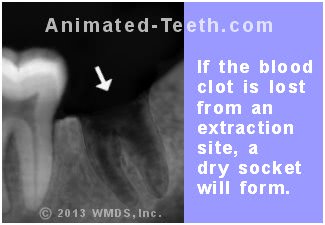
▲ Dry out socket diagram.
A dry socket, more formally termed alveolar osteitis, is a mutual postoperative complexity associated with having a tooth extracted.
It involves a situation where an extraction site'southward healing process is interrupted (delayed) due to the loss of the blood clot that normally occupies the molar's empty socket.
This page's coverage of dry sockets is broken into the post-obit subsections:
- Usual signs and symptoms.
- Dry socket vs. normal healing.
- Pictures of dry out sockets.
- How long do they concluding?
- How long does the pain last?
- Treatment.
- Why practice they form?
- How often do they class? (wisdom teeth vs. other teeth)
Dry socket signs and symptoms.
The predominant characteristics of having a dry socket are:
- Throbbing pain (possibly very intense pain).
- Bad breath (a foul odor and/or bad taste coming from your extraction site).
- Timing of these events where they first appear a few to several days following your tooth'due south extraction.
How can you tell if you have a dry socket?
The key to determining if what yous're experiencing is due to a developing dry out socket is to compare the symptoms you notice with those of normal post-extraction healing.
a) What's normal healing like? What usually happens subsequently a tooth is pulled?
- In about cases, a patient will experience some degree of discomfort from their extraction site on the mean solar day of their surgery. (Hopefully, this will simply be minor.)
- Then with each day that follows, the level of pain they discover gradually tapers off until information technology finally disappears.
- And as each day passes, the site shows continued progress toward healing over the extraction's wound.
b) What's different when a dry out socket starts to grade?
As alveolar osteitis sets in …
- The patient will observe that their initial discomfort does gradually fade over the first few days following their extraction. (Just like with normal healing.)
Just so, usually somewhere between days 2 and 4 after their procedure, their level of pain begins to intensify.
- During this same time frame, the patient may start to detect a bad gustation or odor coming from their extraction site.
- On inspection, the patient will detect that their tooth's socket appears empty. (Evidence of blood clot loss and/or disintegration.) The bony walls of the interior of the socket may be visible.
▲ Section references – Kolokythas
Hither's a recap of the above information in tabular class for comparison.
Dry out socket formation vs. normal healing. – Major differences.
| Dry out Socket formation. | Normal healing. |
|---|---|
| Post-op hurting lessens over the first days but then gets worse. | Levels of post-op pain gradually improve each day. |
| The tooth socket appears empty. (Only some or none of the original blood clot is visible.) | The tooth socket appears relatively total. (With blood clot and developing tissues.) |
| Within the socket, regions of exposed bone are visible. | No visible exposed bone tissue. |
| Bad taste coming from the extraction site. | No associated taste. |
| Bad breath. Foul odor coming from the extraction site. | No associated breath odors. |
Further details near the symptoms of dry sockets. –
1) What does a dry out socket feel similar?
Hurting and discomfort.
With alveolar osteitis, the discomfort from the extraction site usually starts to intensify on days 2 to 4 after the molar was initially removed. (48 hours following the procedure, or later.)
This detail alone is an important characteristic clue that helps to confirm for your dentist that you do in fact have a dry socket.
a) What does a dry socket feel similar at first?
It'due south usually the gradually intensifying, often throbbing, hurting coming from the expanse of your extraction site that's the first tipoff that a dry out socket is starting to form.
b) How bad does a dry socket hurt?
- The discomfort is ofttimes (almost characteristically) described as a boring throbbing hurting.
- It can be moderate to severe in intensity, mayhap fifty-fifty debilitating.
- What's felt may exist abiding or intermittent. In the latter example, the frequency of onset can vary. Later on, the pain is more than probable to be abiding.
- The pain may remain localized to just the extraction site, radiate to other portions of the jaw, or even extend to other areas on the same side of the patient's caput such as the ear or temple, or possibly fifty-fifty the eye or neck. Experiencing headaches is also reported.
- The pain usually reaches its most intense level effectually 72 hours mail-extraction (Bowe). The pain may be so debilitating that information technology causes loss of sleep and affects the person's ability to office.
▲ Department references – Bowe
c) How long does dry socket hurting concluding?
On average, the discomfort normally runs for four to viii days. That means you lot'll probable need attention from your dentist to stay comfortable. How dentists treat dry sockets.
At times the pain may exist quite severe. Toward the end, it will simply gradually taper off and finally disappear.
What does a dry out socket feel like with your tongue?
You'll be able to feel that the tooth'due south socket seems empty and open. (Due to the loss of its blood clot.) You're likely to feel the sharpness of the socket'due south exposed bone surfaces.
A picture of a dry socket.
Annotation the loss of the socket's blood clot and exposed bony interior.
2) What does a dry socket look similar?
- The molar's socket will appear empty instead of being filled in with a claret clot or granulation tissue (new developing tissue) like with normal healing.
(In many cases, the emptiness of the socket isn't readily apparent because it'due south filled with saliva, or accumulated food and debris.)
- The exposed os of the walls of the empty socket is visible. Information technology may be partially covered with a gray/yellowish layer of necrotic tissue or other droppings.
- The gum tissue immediately surrounding the extraction site shows signs of being inflamed (cherry-red, tender, puffy).
How does a dry socket's appearance compare to normal healing?
- With normal healing, the molar'due south socket remains substantially filled. (Offset with the blood jell that forms and and so with the developing tissues that arise from it.)
- No exposed bone is visible.
- The contours of the extraction site continually become more and more than rounded equally the bone and soft tissues of the wound gradually heal over.
3) Additional signs and symptoms.
- Information technology's characteristic that the patient will notice a foul olfactory property (halitosis) or bad taste coming from their extraction site.
- Lymph nodes in the jaw or neck may be tender and enlarged. (A sign of the trunk's inflammation response to conditions associated with the dry socket's germination.)
- Dry sockets are typically non associated with the presence of fever, swelling of the surgical region, or obvious signs of infection (local or systemic).
▲ Main reference sources for entire Characteristics section – Kolokythas, Bowe, Noroozi
4) Dry out socket timeline.
How long does it take to go a dry socket?
Characteristically, symptoms don't start to appear whatsoever sooner than 2 to 3 days following your extraction. 95% of dry socket cases are apparent inside the week following the patient'southward procedure. (Kolokythas)
How long do dry out sockets terminal?
Once a dry out socket has set up in, it usually takes about 7 to 10 days for the extraction site'southward healing process to go geared up again and create new granulation tissue that then starts to cover over and protect the socket'due south exposed bone. Equally this process advances, y'all can expect your symptoms to begin to subside. (Noroozi)
How long does information technology hurt?
The pain from a dry out socket usually lasts for 4 to viii days. At times, the pain may be quite intense. Only as the healing process finally manages to brand progress, the discomfort will finally taper off.
How long is your wound'southward healing process delayed?
In general, you tin await that the healing of your extraction site Normal healing timeline. will be delayed on the order of a calendar week or longer.
How practice yous know when a dry socket is gone?
A dry socket is a fix of symptoms associated with interrupted (delayed) wound healing. As weather condition within the extraction site correct themselves and get dorsum on rail, the symptoms produced by the site'south irritated tissues will gradually subside.
Once your symptoms have disappeared, it'south expected that this complexity has run its course and your healing procedure will continue on to completion.
▲ Section references – Noroozi, Kolokythas
5) How are dry sockets treated?
Pain relievers on their own (over-the-counter pain medications and even prescription narcotics) are seldom fully constructive in managing the discomfort associated with a dry socket.
Treatment.
The almost effective handling for pain associated with a dry socket is one where the patient'southward dentist inserts a special paste (medicated dressing), daily if needed, directly into the wound How that's done.. In a pinch, at that place are some home remedy methods Instructions that can be used to provide pain relief.
Then in conjunction with that treatment, over-the-counter medications (like aspirin, Advil/Motrin/ibuprofen or other nonsteroidal anti-inflammatory drugs (NSAID)), or prescription medications if needed, are used to command whatever level of discomfort continues to persist.
six) How frequently exercise dry sockets occur?
Statistics evidence that experiencing alveolar osteitis is a relatively common mail service-extraction complication. Although, by far, information technology's most mutual following wisdom teeth removal.
An impacted lower third molar slated for extraction.
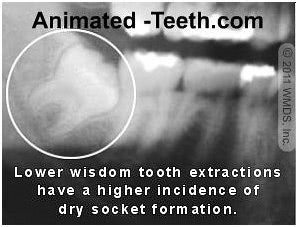
The potential for dry socket formation is a concern with these extractions.
- For routine tooth extractions, the chances of experiencing a dry socket run on the lodge of i to 4%.
- They're much more likely to occur with lower tooth extractions than upper ones.
- In general, surgical extractions (similar impacted wisdom tooth removal) have a tenfold college incidence rate.
- As many as 38 to 45% of mandibular (lower) wisdom molar extractions (see film) are complicated by the subsequent formation of a dry socket.
- With all tooth extractions considered collectively, a dry socket is the nigh mutual post-surgical complication.
▲ Department references – Cardoso, Bowe
Etiology – Why do dry sockets form?
Enquiry and clinical observation have identified a number of factors that correlate with a patient's risk for developing alveolar osteitis. Agreement these factors can be useful in preventing this condition.
Dry socket adventure factors.
- Previous history of dry sockets. | Extraction difficulty. | Failing to follow aftercare instructions. Details.
- Cigarette smoking/Tobacco products use. | Taking nascency control pills. | Age. | Tooth location. Details.
Post-obit your dentist'due south post-operative instructions is important.
Every bit noted above, failing to follow your oral surgeon or dentist's instructions (specially those that address blood clot formation and retention) places you at an increased risk of experiencing this complexity.
For more information, our pages Post molar extraction instructions – Outset 24 hours. Next mean solar day and beyond. cover this subject in detail.
The mechanism of dry out socket formation.
The verbal pathogenesis of the formation of alveolar osteitis is not fully understood but it is known that the following factors are involved.
1) The claret clot is lost.
A course of events takes place where the blood clot that normally forms in a tooth's socket post-obit its removal isn't properly retained. Information technology either:
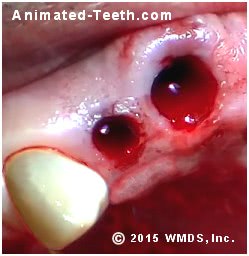
The claret clot that begins to form immediately after an extraction is an of import part of the healing process.
- Information technology disintegrates by way of a chemical process termed fibrinolysis.
(Fibrin is a tough gristly protein whose germination is triggered past the clotting process. Pieces join together to form long strands that and so crosslink with others. As this process continues, and the web that's formed snares platelets, it develops into what's referred to as a blood jell.)
Information technology's hypothesized that the compounds responsible for this fibrinolytic action may come up from the socket's bone itself, either as a consequence of infection or as a result of trauma created during the extraction process. (Noroozi)
- It is dislodged by an event or activeness.
(Common scenarios involve loss of the jell as a event of vigorous swishing, rinsing, spitting, or the cosmos of a sucking action, similar when drinking using a straw.)
▲ Department references – Noroozi
If the blood clot is lost, the socket's bony interior is exposed instead of protected.
2) Healing is delayed.
The lost blood jell would take played an of import function in the healing procedure of the extraction site. However, due to its loss, the progress of the socket's healing is interrupted (delayed).
three) The socket's bone tissue becomes exposed.
The clot would take also covered over and protected the bony walls of the molar's empty socket as information technology heals. At present that information technology's been lost, the walls are exposed and become irritated, resulting in (possibly intense) pain and sensitivity.
Our next page outlines how dentists treat dry sockets. ►
Page references sources:
Bowe DC, et al. The direction of dry socket/alveolar osteitis.
Cardoso CL, et al. Clinical concepts of dry socket.
Kolokythas A, et al. Alveolar Osteitis: A Comprehensive Review of Concepts and Controversies
Noroozi AR, et al. Mod concepts in understanding and direction of the "dry out socket" syndrome: comprehensive review of the literature.
All reference sources for topic Dry Sockets.
Comments.
This section contains comments submitted in previous years. Many accept been edited then to limit their scope to subjects discussed on this page.
Annotate –
Hurting and odor mail service 8 days
I received resorbable sutures after having all four wisdom teeth extracted. It has been a calendar week since the surgery and I have a terrible odor/sense of taste in the dorsum of my mouth constantly. Well-nigh similar to a fishy smell. This smell is accompanied by pain from the cheeks to the jaw on both sides of my confront. Without ibuprofen and Tylenol it is unbareable. I am taking amoxicillin and prednisolone only have almost finished the he round of anitibiotcs prescribed. How normal is any of this?
Jt
Reply –
What you lot need is evaluation by your dentist. Even via initial telephone contact they should be able to develop a fair thought of what is going on and what type of attention you require.
As you'd expect, the usual course of events would exist one where pain diminishes with time. Some of what y'all report seems consequent with a common postoperative complexity referred to as a dry socket. That might explain what is going on. Your dentist volition need to make that decision.
Staff Dentist
Source: https://www.animated-teeth.com/dry-sockets/a1-dry-sockets.htm
0 Response to "How to Know When You Have Dry Socket"
Post a Comment