Where to Get Your Art Fix in Beijing Nymag
Is Terence Koh's Sperm Worth $100,000?
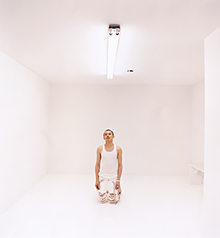
Terence Koh'south artistic coming-out hardly seemed auspicious. Information technology was May 2003. Collector Javier Peres had recently scrapped his international-law career to open Peres Projects gallery. He offered its opening show in Los Angeles to Koh, a young New York artist then known as asianpunkboy, whose track record consisted of little more a perverse and freewheeling Website and a few 'zinelike books. As art openings go, it proved to be bizarre. Artist–designer–gay icon Ryan McGinley played D.J., and there was no art in the gallery itself. Through a hole in its flooring you entered the basement, which Koh had transformed into an all-white space inhabited by two albino parakeets. "The Los Angeles art world was like, 'You had a party, not an opening, and there's no art in your gallery. You're a joke,' " remembers Peres.
Fast-frontward iii years and jet halfway around the earth to Switzerland, where in June crowds flocked to see Koh's solo installation in Art Basel'due south invitational "Statements" section. Through give-and-take-of-mouth, the work—which included glass vitrines containing fist-size gold-plated chunks labeled as Koh's ain excrement—had get one of the off-white's signature pieces. More than a dozen collectors fought to buy upwards the various components, whose total selling price approached $500,000.
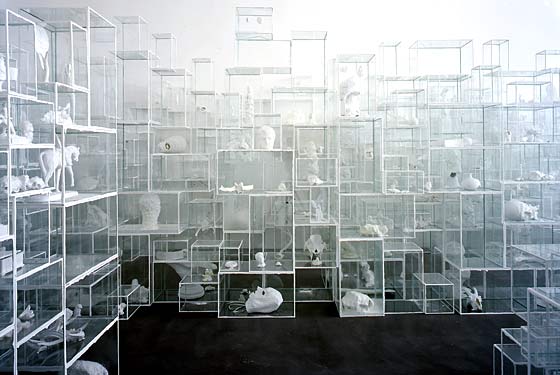
Even in an art earth marked by the speed with which new stars rise (and fall), Terence Koh'southward trajectory is phenomenal. After Art Basel came the flavor-opening testify at the prestigious Kunsthalle Zürich, which allocated him more than viii,000 square feet of space; Koh blanketed one huge room in white powder—walking inside felt similar of a sudden being caught in a fog bank—and filled another with one,200 glass vitrines stacked to form a precarious labyrinth. Vi weeks later, the godfather of the British art marketplace, Charles Saatchi, and his curatorial marry Norman Rosenthal awarded Koh the pole position just inside their controversial "U.s. Today" testify at London's Regal Academy, where Koh showed CRACKHEAD, a wall-like organization of 222 vitrines containing plaster heads covered in a festering mold owing to the humidity trapped inside.
Capping Koh'south run, the Whitney Museum will open its 2007 program on January 19 with a solo show in the ground-floor gallery devoted to spotlighting immature artists. The stakes are loftier. "Being in the Whitney is like having this huge magnifying glass shining on you," says Koh. "If I fail, I fail spectacularly in front of the whole fine art globe. That in a way relieves the pressure, because either way, the splatter will be beautiful."
The Whitney opening—followed by a Koh-hosted all-white after-party à la Truman Capote at Deitch Projects downtown—marks the creative person's triumph in a city where not and then very long agone he couldn't afford studio space. In October, Koh moved back to New York afterwards a three-month sojourn in Berlin. He took over an entire building on Canal Street, painted every exposed surface white, and designated it the new home for his Factory-manner gallery project, Asia Vocal Society (ass). Koh shares the upstairs with his longtime young man, Garrick Gott, a graphic designer. Peres Projects director Blair Taylor manages the gallery'southward roster of New York artists from an office directly below their apartment. In the basement volition exist a sort of clubhouse for the hard-partying downtown art coiffure, which includes artists such as Peres Projects stablemate Dan Colen, too as Banks Violette, Barnaby Furnas, Dash Snow, and McGinley.
On the afternoon I stop by, just before Christmas, Koh is having a shoe crisis. He and Peres are planning to fly to Toronto early the next morning for the wedding of gay filmmaker Bruce LaBruce to his Santeria-priest lover, and Koh needs some white pumps. He calls an SUV car service, puts on "the monkey fur" (a hypnotic white couture coat that looks similar it was stripped from a yeti's dorsum and stitched past elves into a sort of winter bolero), and heads to Patricia Field.
Given his swallowlike frame, Koh has humongous feet, and the store doesn't have white pumps in his size. Improvising, Koh spies a silver version with three spikes jutting from the toes and buys two pairs: the ones in stock, which he plans to razor-slit and so he tin can habiliment them to the wedding, and a pair commissioned to fit him. The shoe crunch solved, Koh and Peres storm 7 for some Bernhard Willhelm. Speed-shopping both the men'due south and women's sections, they rack up a iv-digit neb in 15 minutes. (Koh is particularly pleased with a pair of white shorts that were in one case knee joint-length but have been lacerated into lingerielike laciness.) On the way out the door, they notice a silver necklace that looks similar a cross between a feather boa and the sort of thick dookie rope popularized by rappers in the eighties. Peres, in full carbohydrate-daddy dealer mode, caps the shopping spree by ownership information technology for Koh. It'southward beautiful but heavy and sharp. By the time we get back to the circuitous on Canal, Koh'south swan neck is an angry, rashy red. "It'south not the offset fourth dimension I've caused you hurting," jokes Peres.
The human relationship between dealer and artist can be businesslike, only it sometimes grows into something more emotionally charged. "Javier used to exist my lover, but at present is only my dealer," Koh explains via email. "Nosotros probably have the closest relationship in the whole of the art world. He has never asked me virtually why I do a piece or my motivations or ideas or feelings for information technology. He makes it all upwards for the world and it's a perfectly happy symbiosis." That synergy is partly responsible for Koh's tremendous market place success. "When an artist and dealer who reflect the electric current time work together similar Terence and Javier, things happen chop-chop—as with Leo Castelli representing Jasper Johns and Roy Lichtenstein in the early sixties," says veteran art dealer Mary Boone, who had her synergistic moment with Julian Schnabel and David Salle.
Explaining their collaboration, Peres says, "We can talk very candidly about the marketplace problems without information technology being viewed equally a vulgar topic. He'due south always alluding to the Chinese merchant culture. Terence jokes most the combination of the Jew and the Chinese being able to figure things out." Information technology'due south non just between them that Koh is aboveboard. Koh once posted online how much money he claimed to have earned equally an artist in 2004: $153,782. Fifty-fifty conservative estimates for his 2006 take would break a one thousand thousand dollars. "I love coin," says Koh. "Having money is the grease that helps me run my other crazy projects, like my magazine and my Website and the new porn production company I am setting up in my basement."
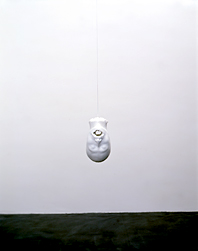
Koh was particularly fortunate to hook up with a dealer able to fund (and sell) anything he conceives. Peres spent about $400,000 on an art associates line in Berlin to produce the 1,400 vitrines required for Koh's Zürich and London shows. Twenty-eight administration worked for 3 months "whiting" the objects Koh collected from sexual practice shops and flea markets. Peres's investment promptly paid off. The Kunsthalle vitrines, grouped into some ten sets priced between $65,000 and $265,000, sold out. The other objects in the show—a set of white-chocolate paintings, a suspended double-sided mold of Koh's head, and two towering white-chocolate sculptures (part mountains, part Twin Towers, part phalluses)—brought in $400,000. Also, the installation at the Royal Academy price super-collector Saatchi more than than $200,000.
Those are high prices for a young artist, fifty-fifty considering Koh's huge product costs. But what'due south shocking is that collectors are willing to pay such prices for pieces of uncertain durability. From the outset, Koh has fabricated a habit of using unusual materials: chocolate, semen, blood, vomit, Chanel lipstick. At kickoff, Koh and Peres fabricated the fault of selling the work without detailing its fragility. "In our rush, our naïveté, it seemed clear that this work was going to change—I mean, it was fabricated of ashes and chocolate. And collectors would later come and say, 'This broke, tin can you fix it?' " Peres recalls. "Now, no work of Terence leaves my gallery without a release, considering his materials are quite unusual. We simply don't know what will happen to a piece made out of chocolate and Terence's come."
Koh occasionally consults with buyers when a work degrades, deciding whether it should be replaced, restored, or left alone. Collectors Phil and Shelley Aarons bought a 2004 slice called Michael Jackson, Michael Jackson—ii fourteen-inch figures of Jackson in his "Thriller" and "Beat out It"–era costumes, covered in chocolate—which over fourth dimension started to plough white. They were not new to the unpredictability of Koh's work. In fact, the pair had commissioned what Koh calls his first real artwork: an artists' book set that incrementally transmogrified into a huge mirrored bury, packed in white powder, lined in white fur, filled with 220 private cases, and weighing half a ton. "I gave him my FedEx number when he called to say information technology was done," Phil says with a laugh, "and he said, 'It can't be FedExed.' " Still, he and his wife were concerned past the whitening Michael Jacksons. "Terence came over to see them," the collector recalls. "He said, 'Information technology's even better at present; it looks more like Michael Jackson.' " The figures, lightly crusted, stand up immediately inside the door of the Aaronses' flat near Lincoln Center.
In one sense, this cloth instability functions as a collector purity test. Because while Koh's rocketing market invites speculation, only a fool buys perishable work for investment purposes. That said, such fragility attracts collectors who pride themselves on supporting "avant-garde" art. Moreover, Koh's heated market has had an alchemic effect on more run a risk-averse collectors. "Terence's work is sometimes covered in fingerprints, contains dirt and spiderwebs, and information technology's often broken or already developing mold when you lot buy it," points out London dealer Nicolai Frahm, who started collecting Koh in 2004. "Simply with hype and high prices, those pieces somehow seem more than aesthetically appealing to new collectors. That was also the situation with Paul McCarthy or Mike Kelley. Their art seemed likewise tough at $xxx,000, simply at one-half a million they're much easier to eat."
I t may be tempting to chalk up Koh'south market ascendancy purely to Peres, merely there would be no hype if there weren't something substantive to promote. Koh's work isn't all about the easy affect of gold-plated excrement and all-white rooms. What intrigues curators and collectors is that with each installation, he's constructing an idiosyncratic and visually stunning universe. "It'due south always a risk to give someone such a big infinite, especially if artists are realizing their beginning large solo exhibition," explains Kunsthalle Zürich director Beatrix Ruf. "It can be frightening. Simply Terence definitely is non afraid. He has an incredible formal ability, the ability to practice several things in parallel, and of course, the right urgency. He's very obsessive. Very precise. And he doesn't give in."
Indeed, Koh has a peculiarly sharp vision. He's normally lumped with Gothic Revival artists such as Banks Violette, Aïda Ruilova, and Sue de Beer, because his work is dramatic and occasionally all blackness. Simply what makes Koh compelling is his command of space (he once worked for architect Zaha Hadid) and a formal fashion akin to the Japanese aesthetic of wabi-sabi, jubilant the beauty found in decay and impermanence. "As a child, I actually enjoyed going to Asian funerals," he recalls. "I loved that nosotros all had to dress in black for xiv days and and then on the actual cremation day everybody was in white … Maybe that is what struck in me the monochromatic colors." An in-your-face up gayness as well dominates his work, be it the engorged penis on his home folio, the human-children he deploys in his performances, his utilize of come as an fine art material, or his inviting Armory Show fairgoers to an "opening" that was really a gay backroom. It's hard to come up with a prominent artist since Robert Mapplethorpe or David Wojnarowicz whose homosexuality has been employed then provocatively.
"If I fail, I neglect spectacularly in forepart of the whole art world. Either mode, the splatter will be beautiful."
Distinguishing betwixt Koh'due south life and his art is nigh impossible. "I don't think of Terence making individual pieces," says artist AA Bronson, a founding member of the conceptual group General Idea. "It's ane circuitous slice. An most fictional autobiography, one extended work. Artists like Dieter Roth, Yoko Ono, and Ray Johnson all made these little projects that were office of the fabric of their life. Terence does that also." The details of that autobiography constantly shift to his reward. Koh grew up in Canada, but printing materials state that he was born in Beijing, and his nascency appointment has advanced over the years from 1977 to 1979 to 1980. Bronson chuckles: "Terence lies about everything. I think he was built-in in Singapore. And my guess is he's almost 36."
Bronson, whom Koh considers a sort of male parent figure, worries about the speed of his sometime studio banana's success. "I really hate seeing artists take off that fast, considering they most always crash," Bronson says. "Terence is the real thing. But even existent deals tin can burn down out. I say that to him all the fourth dimension." Helping set the pace of an creative person's career is i of a dealer's primary functions, and Peres'south balls-out speed raises eyebrows. "I see young artists equally embers to exist patiently fanned into flame. Javier's approach appears to be more than like pouring gasoline on it," says Becky Smith of Chelsea's Bellwether Gallery. "Telephone call me old school, but when it comes to an artist's trajectory, I look at the whole 'Kaboom!' thing suspiciously."
The pitfall here is that getting the art earth's attention is kid's play compared with keeping it. "He'due south in a very interesting moment," observes Ruf. "Some artists don't even get looked at, but others take the problem of just being fascinating. People are fascinated by Terence's objects and the white spaces. But as an artist, you have to ensure they have an experience beyond that commencement fascinating moment. That'south a challenge Terence volition take to confront but as Andreas Gursky and Jeff Koons did."
Information technology's impossible to say whether the Whitney installation will evangelize the blazon of transcendent experience Ruf describes, simply information technology certainly shows that Koh won't let himself be labeled a one-trick pony. There are no vitrines. No white pulverization. Nothing cleaved, decomposing, or vaguely sexual. Instead, inside a pristine room will stand a spindly tripod holding a motion-picture show spotlight, 600 degrees Fahrenheit at its surface and emitting an artificial daylight visible yards abroad on Madison Avenue. "It casts hypersharp shadows even in the middle of the twenty-four hour period," says curator Shamim Thou. Momin, who besides selected Koh for the 2004 Whitney Biennial. "You'll walk in, start to sense that information technology's crazy bright, then turn and have it explode into your vision. The thought is to evoke a concrete sensation that is both painful and amazing."
Adjacent upwardly for Koh is a group show at London's Victoria Miro Gallery, another solo exhibition during Art Basel, and a public-arts project in Beijing planned to coincide with the 2008 Olympics. Not to mention plans to start working with a heavy-striking European gallery. Despite Bronson's advice, Koh does not fear fizzling. "I call back it'south quite elegant when a star starts burning out, becoming much brighter and then eventually imploding and becoming a black hole, becoming antimatter," he says. "I look forward to it. Just not for a billion or and so years."
Source: https://nymag.com/arts/art/features/26275/
0 Response to "Where to Get Your Art Fix in Beijing Nymag"
Post a Comment