Famous Black and White Photo Couple in the Rain Art Print Poster Dean
For those of usa who grew up in the 1960s-1970s, certain things jump out at us and just shout 'groovy!' Avocado-colored refrigerators. VW Beetles. Richard Nixon. OK, not Nixon, only you get the point. Like all generations, we are nostalgic for what we had as children and teenagers/young adults. And one of the things we almost all had to grace the walls of our suburban bedrooms (other than wood paneling) were wall posters. Cracking wall posters! Here is a list of ten of the well-nigh iconic wall posters from that era. I deliberately left off this list wall posters that depicted the following – sports figures (Joe Namath, Ali, etc.), moving picture stars (Farrah Fawcett and her reddish one piece swimsuit pose), musicians/music/bands (Woodstock, Hendrix, etc.), movies (Star Wars, Jaws, etc.), and celebrities (John Travolta, Raquel Welch, etc.). These could exist topics for time to come lists.
This listing will focus on ten of the top iconic posters from that era. Artwork, genres, images, symbols and ideas that are still around today, or which have long since slipped into obscurity. Though wall posters peaked in popularity with the end of the 1970s, you can notwithstanding find these vintage posters on Ebay and other locations – many of them commanding acme prices in good condition. So turn on the AM radio station, plough off the lights, burn down up your black light bulbs, low-cal a joint, sit back and bask x acme iconic 1960s-1970s wall posters.
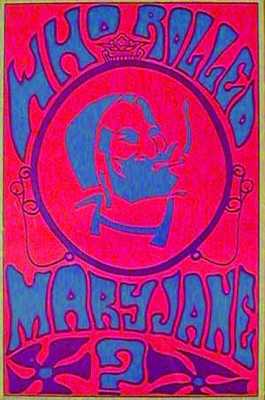
Near wall posters from this era were either meant to be funny, psychedelic, sexual, a depiction of a piece of the culture of the fourth dimension (a movie or sports star, a popular type of muscle machine, a TV show, etc.) or a protest motility. Probably the most pop drug-related wall poster of the 1960s-1970s were those depicting the most popular drug of that era – marijuana (pot, dope, etc.). Some were blackness light posters with black velvet backgrounds and bright green marijuana leaves in the foreground. Others pictured bongs and water pipes and diverse drug paraphernalia. Still other posters depicted groovy people of the era smoking a joint. Probably the most pop of this variety and perhaps the most iconic pot wall poster of the era was entitled 'Who Rolled Mary Jane?' This poster depicted the 'Zig Zag' man, the iconic three quarters paradigm profile of a hippie smoking a doobie that graced the Zig Zag rolling newspaper line. The words 'Who Rolled Mary Jane?' were printed above and below him.

An iconic 1970s symbol designed by a cartoonist Ron Cobb in 1969 was the Ecology symbol. The environmental symbol was first published in the Los Angeles Free Press, and Mr. Cobb placed the symbol in the public domain. It shortly took off, gracing buttons, T Shirts, and of course, wall posters. The environmental symbol was very pop and widely seen for the side by side 10-xx years before most disappearing. Today we more than unremarkably associate the recycle symbol, or just a dark-green leaf, with ecology. Simply in the 1970s, it was this symbol. Mr. Cobb used the words 'environmental' and 'organism' as the root of his symbol using the letter 'e' and 'o' and placing them on tiptop of i another. This formed a letter like to the Greek alphabetic character 'Theta'. The symbol is either green with a white background or a white symbol on green.
The symbol was, similar the raised fist, a symbol of solidarity of the new environmental movement, and a call to action to save the environment from the rampant pollution of the twenty-four hour period. As a young boy, I recall very well the kickoff recycling centers in my town. If you brought cans, glass, newspaper, and other materials to the county park for recycling, you were given a small sapling tree to plant. Thousands of people did so and I often wonder how many of those sapling trees were planted and survived? Today they would be a woods of forty yr-onetime, mature trees.
This was the showtime era of environmental sensation in the United States that resulted in the nascency of the environmental movement, Globe Day, recycling, and what we now phone call existence 'Green.' In the aforementioned yr the ecology symbol took off on wall posters, the United states adopted strict environmental protection regulations for the showtime time and created the Ecology Protection Agency. In a 1970 issue of Look mag, the symbol was placed where the stars are on the American flag and the thirteen stripes were alternated green and white – thus creating the 'environmental flag of the United States.' This flag, and the symbol itself, were widely seen on wall posters for many years.
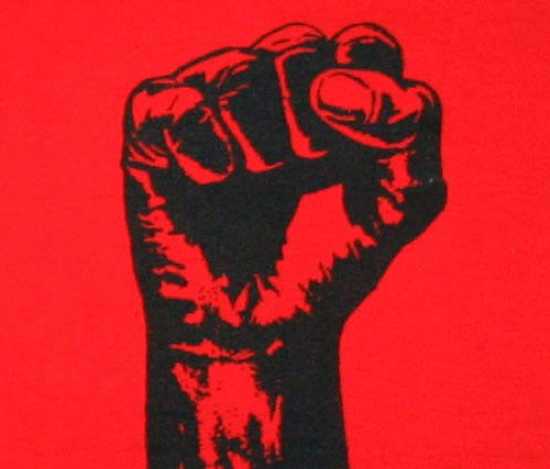
Called 'The Raised Fist' or 'The Clenched Fist,' this is a symbol mostly known for representing the image of 'Black Ability' in the 1960s and 1970s. Many posters from that era had the Black Power raised black fist, simply you could too observe posters with the fist colored in rainbow (peace, love) colors, the colors of the American flag (red white and blueish), colored white (White Power), etc. The clenched or raised human being fist symbol was all over the place during this era. Information technology symbolized unity and solidarity of groups against all manner of societal evils and issues of the time, be it racism and segregation or the Vietnam war.
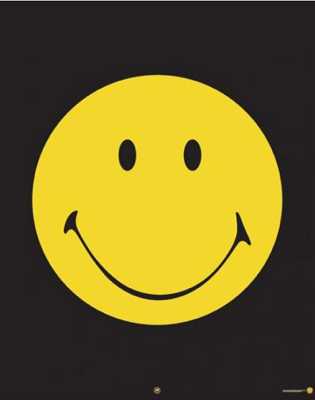
A simple xanthous circle with ii optics and a grin, the smiley face was everywhere, including wall posters. Today we run across the smiley confront most often as an 'emoticon' placed next to things nosotros type or run across on the cyberspace that we 'like.' But back in the days before computers, the smiley face meant something else. The paradigm we all came to know and love (or despise) was originally created in 1963 as a motivational epitome for employees of the State Mutual Life Assurance Visitor by 1 Harvey Bell. By the early 1970s, the paradigm was jumped on by savvy business people to sell all mode of items such equally T Shirts, bumper stickers, java mugs – all with the smiling confront and likewise the words 'Take a Squeamish Mean solar day!' The overuse of the smiley face and this argument before long became a contemptuous joke, significant just the opposite of what information technology was intended. Information technology was annoying, non motivating. Yet, the smiley face kept correct on smiling. It is even so with us today, not so much on wall posters anymore, simply everywhere on the internet.

The peace sign (symbol) that graced countless wall posters in the 1960s-1970s was originally created in England as a protestation to nuclear armament and nuclear war. Symbols for peace have been with flesh for ages (the palm co-operative for example). The specific peace sign nosotros recognize from the 1960s-1970s was designed with the semaphore code for the letters 'N' and 'D'. In semaphore code, the letter 'N' is created past the user crossing both flags at their waist into an inverted 'V' shape. The 'Northward' stood for 'Nuclear.' To create the letter 'D' in semaphore code, the flagger raises i flag straight over their head, and one flag straight to the ground creating a vertical direct line looking like the letter of the alphabet 'I'. The 'D' stands for 'Disarmament.' Place the ii semaphore symbols on acme of each other (an inverted 'V' and an 'I') inside a circle and you take the modern peace symbol. The peace symbol created to protest British nuclear artillery quickly became the universal symbol for peace, especially as it related to the Vietnam War.
5
The Thing/Middle Finger
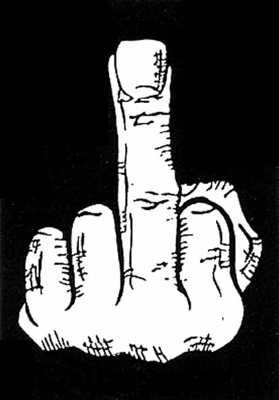
Perhaps this poster was a reaction to the peace symbol posters popping up everywhere in the 1960s-1970s? Whatever its origin, it caught on and at that place were several variations of this popular poster, but all of them with a 'thing' (a round-bodied, furry, evil faced guy with a smug grinning) flipping the bird to the viewer of the poster. Typically the thing is seen leaning with one arm against an invisible wall, with his (its?) legs casually crossed.
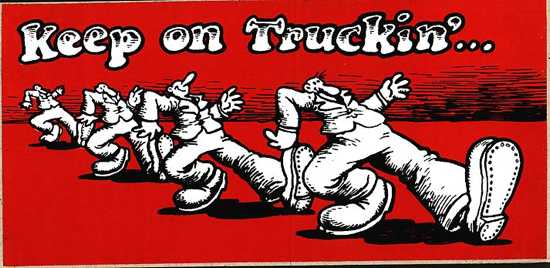
A existent icon of this era, this epitome was drawn from the commencement issue of counter culture 'Zap' magazine. The image was a drawing created by noted counter-culture artist Robert Crumb. It depicts several men, adjacent, one leg forward, strutting downwardly a highway, or through a field, or over all manner of landscapes with the words 'Proceed on Truckin.' The drawing was Nibble's take on the lyrics of the Blind Boy Fuller song "Truckin' My Dejection Away". Crumb intended the cartoon to be anything other than what information technology chop-chop became, a commercialized (and often plagiarized) representation for the entire 'hippie' era. Nibble said the cartoon was the worst thing that ever happened to his career. The last matter he wanted to become was 'the greeting menu artist for the counter culture.' I myself had a T-Shirt with a articulate rip off of the image of the men strutting down a street only with the words 'Just Passin' Through!' As I remember, with anybody else wearing 'Continue on Truckin!' T Shirts, the girls found mine to be pleasingly different.
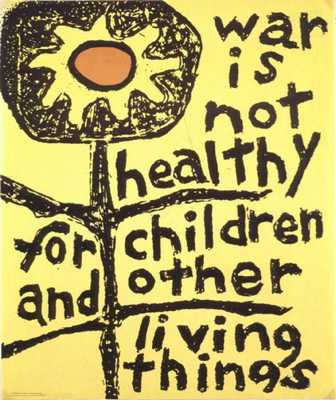
Full Championship: State of war is Not Healthy for Children and Other Living Things
Other than the peace sign, this may exist the most instantly recognizable poster from the 1960s-1970s era. It has an interesting history also. The original fine art work for the affiche came from a grass roots anti-Vietnam state of war movement called 'Another Mother for Peace' (AMP). Started in 1967 past writer Barbara Avedon (who among others, created the hit TV testify Cagney and Lacey) it came out of Avedon'south fear that her new built-in son would grow upwardly to fight in more than wars like Vietnam (which she opposed). She invited other neighborhood women to join her in starting the movement which was 'dedicated to eliminating the apply of war as a means of solving disputes among nations, people and ideologies… and advocate peace'. A local artist, Art Schneider, donated his paradigm of a sunflower ready against a brilliant xanthous background with the words 'War is Not Good for you for Children and Other Living Things.' The plan by the AMP was to send the cards with this paradigm to President Johnson and all members of congress, on Mother'due south Day, asking for peace and an cease to the Vietnam state of war. The initial order of 1,000 cards was soon exhausted and thousands more were made and sent to members of congress, the President, and leaders of behemothic corporations. The image of their motion quickly became popular and soon turned into posters that graced the walls of untold thousands of rooms throughout the earth. Information technology remains, along with the peace symbol, a universal argument against war and for peace.
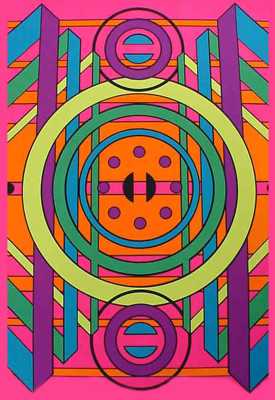
Certainly the type of wall affiche near associated with the groovy 1960s and 1970s has to be the black low-cal poster. There were many pop themes for black light posters, sex activity, drugs, rock n roll, but probably the most popular were the psychedelic pattern posters that, when viewed under black light atmospheric condition (especially when stoned, or so I was told) created all manner of groovy, spinning, and morphing patterns, swirls, and other hypnotic hallucinatory furnishings. As Yoda might have said – 'far out, they were.' Merely all blackness lite posters shared one thing in common, phosphorous ink that would fluoresce under ultraviolet (black) light. To be viewed properly the blackness light wall poster needed to exist seen in dark atmospheric condition with simply the blackness lite illuminating information technology. This meant that all bedrooms containing black light posters were always dark with shades and blinds fatigued and all other lights turned off or severely dimmed. Inbound such a realm, from the outside, was ever an interesting experience until your eyes adjusted to the darkness and the ultraviolet light. Then the total glory of the black light affiche would slowly come into view. That was of course, bold you could run into it through the haze of smoke. Over again, and then I was told.
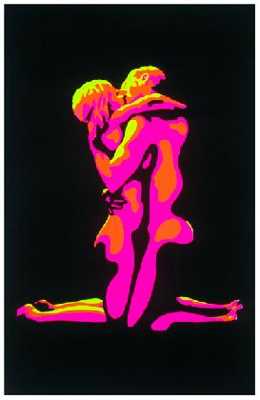
The 1960s and 1970s were the era of sex activity, drugs and rock north whorl and all three were aptly represented in wall posters from the era. One of the near popular posters from the 'sex' genre was titled 'Flaming Love.' Typically it was a black light affiche. The paradigm was a side-on depiction of two young figures, ane male person, ane female, on their knees facing each other in a tight loving or sexual embrace, kissing. There were no words or writing on the poster, just the prototype of the two people embracing.
There were many other variations on this theme. Some other popular wall poster from that time was the Zodiac Sex Position wall poster. This depicted the twelve signs and names of the Zodiac and a unlike sexual position for each month. The two figures from the 'Flaming Love' poster were back, but this fourth dimension instead of a tender and loving cover they were placed in all manner of sexual positions – some of them extremely challenging. For example, if your nascency engagement vicious nether the sign of Pisces, the ii young figures were depicted having regular quondam missionary position sex. However, the two lovers were very busy and 'getting it on!' for the signs of Cancer, Leo, or Virgo. Non simply did they demand to be very flexible, athletic, and audacious to accomplish these positions, they also needed a pocket-size stool to sit on! But it was those built-in under the sign of Taurus who had the near Olympian of sexual activity position on this calendar. Proficient luck.
Source: https://listverse.com/2012/08/07/10-iconic-60s-and-70s-wall-posters/
0 Response to "Famous Black and White Photo Couple in the Rain Art Print Poster Dean"
Post a Comment